

GDIZ: inside the new industrial zone reshaping Benin
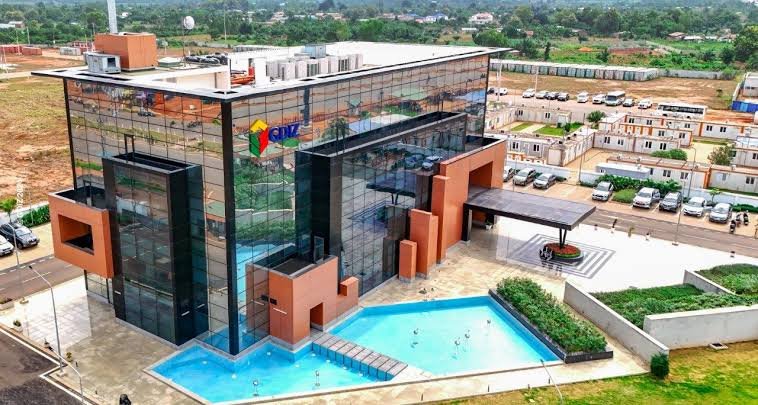
In Tangbo, in the commune of Zè, the Glo-Djigbé Industrial Zone (GDIZ) has in just a few years become the symbol of Benin’s industrial transformation. An overview of a project already drawing attention across the region.

Some forty kilometres from the port of Cotonou, the Glo-Djigbé Industrial Zone now covers 1,640 hectares, developed in three phases through a public-private partnership between the Beninese state and the ARISE IIP group. The project company, SIPI-Bénin, is 35% owned by the Republic of Benin and 65% by ARISE IIP — a split that sums up the arrangement: the state provides the land, the regulatory framework and the political will; the private operator provides the capital, the zone engineering and the industrial contacts. The first phase, completed over 400 hectares, is already largely occupied. Ultimately, the platform is expected to mobilise at least 1.4 billion dollars of investment and create nearly 300,000 jobs by 2030.
The choice of location is no accident. Glo-Djigbé lies on the axis linking Cotonou to the north of the country and, beyond, to Niger and Burkina Faso; the zone is connected to the port by a dedicated road and has a land reserve that a saturated Cotonou could no longer offer. Above all, the site embodies an economic bet made openly since 2016: stop exporting raw materials and process them locally instead, capturing at home the added value that used to go abroad.
Cotton is at the heart of this bet. In recent years Benin has risen to become Africa’s leading cotton producer, but the vast majority of its fibre left the country without being spun. On the platform, companies such as Benin Textile S.A. (Btex) and Benin Textile Corporation (BTC) now turn this cotton into yarn, fabric and “Made in Benin” clothing, while training young tailors in industrial trades — a skills link that barely existed ten years ago and on which everything else depends.
A deliberate industrial diversification
The zone now hosts some thirty investors, around twenty of which already have operational units, for a total of about 18 to 20 production units in operation. Alongside textiles have come agro-processing (soya, cashew, shea), pharmaceuticals, phone and computer assembly, woodworking, packaging — with the company Unicarton — and even ceramics, through African Ceramics Solutions and its ELANO brand, made from kaolin, clay and granite mined in Benin. This diversity is no accident: it protects the zone against a market downturn in any single value chain.
This industrialisation goes hand in hand with a proactive trade policy. Benin has gradually restricted the export of raw materials — the ban on exporting unprocessed cashew nuts, in force since April 2024, is the most talked-about example — in order to steer the raw material towards domestic factories. For manufacturers based at Glo-Djigbé, the measure secures supply; for producers and traders, it first meant sometimes tough renegotiation of purchase prices. It is one of the tensions the platform will have to manage over time.

A model the region is watching closely
Run by the Industry Investment and Promotion Company (SIPI-Bénin), the GDIZ is gradually establishing itself as a continental showcase for Benin’s industrialisation strategy. President Romuald Wadagni presented it in July 2026 at an Afreximbank strategy retreat in Addis Ababa devoted to why industrialisation policies so often fail in Africa — a telling framing: Benin is not just selling a zone, it is selling a method.
A few days later, a Nigerian delegation led by Vice-President Kashim Shettima visited the site. Nigeria is preparing the first phase of a programme of eight agro-industrial zones and explicitly intends to draw on the Beninese experience. The president of Afreximbank, George Elombi, also visited the platform at the end of July 2026 to see the progress of the production units. For a country of twelve million people next to a market of more than two hundred million consumers, turning its industrial model into an intellectual export is no small achievement.
Then there is the question of work. The 25,000 jobs already created on the platform mostly involve young people trained on site, in trades — line operation, maintenance, quality control, workshop supervision — that had no established training path in Benin. A land reserve of about 50 hectares is planned for workers’ housing, a sign that the question of life around the factory is being taken seriously, but also that the zone is in effect creating a new town whose services will have to be funded.

In figures
- 1,640 hectares in total, of which 400 hectares already developed in phase 1
- 1.4 billion dollars of investment expected
- More than 25,000 jobs already created on the platform
- 300,000 jobs targeted by 2030
- About 50 hectares of land reserved for workers’ housing
What the GDIZ concretely changes for an entrepreneur
The most common mistake is to believe that the GDIZ only concerns manufacturers able to put up several billion FCFA. In reality, a platform of this size generates three families of opportunities, and the last two are largely open to Beninese SMEs as well as to diaspora entrepreneurs.
- Setting up in the zone. The entry point is SIPI-Bénin for land and zone services, and APIEx for investment formalities. The special economic zone regime opens customs and tax facilities whose details change: get them confirmed in writing before finalising your financing plan.
- Supplying the zone. Industrial maintenance, transport and logistics, secondary packaging, catering, industrial cleaning, security, technical training, digital services: every production unit set up creates recurring demand that local providers can capture.
- Supplying the zone with raw materials. Agro-processing units are looking for regular volumes and consistent quality. For a producer group or a well-structured cooperative, a multi-year supply contract is often worth more than a one-off good price on the open market.
Points of caution
A platform of this scale also concentrates risks that it would be dishonest to ignore. The first is dependence on a single operator: the model’s success relies heavily on ARISE IIP’s ability to keep attracting manufacturers. The second is skills: between the target of 300,000 jobs and the 25,000 existing posts, the gap will be closed by training, not by spontaneous recruitment. The third is strategic inputs — energy and water — whose continuous availability determines industrial output far more than tax incentives.
There is also a commercial challenge: processing locally only makes sense if finished products find outlets. The African Continental Free Trade Area (AfCFTA) and the proximity of the Nigerian market are the exit bet; this favourable geography still has to be turned into real contracts, which requires standards, certifications and reliable logistics.
Key takeaways
The GDIZ is not just an industrial zone: it is a full-scale demonstration of a strategy — restrict raw exports, attract processing industry, train the workforce on site. For entrepreneurs and diaspora investors, it shows concretely what “investing in Benin” means today: a structured framework, identified value chains, clear political will. The real question for a project leader is not whether to set up a factory there, but where to position themselves in the value chain it creates.
Sources: La Nouvelle Tribune, July 2026 · Banouto, May 2026 · CADRECO, May 2026 · GDIZ Benin / ARISE IIP · SIPI-Bénin.

Business journalism in Benin and West Africa. Write to us: redaction@akeda.media
Read next

Aimée Ogouma: structuring, enhancing and positioning local SMEs
Mark’Éthic (SENS Bénin group)She helps Beninese SMEs structure their offer and access markets…

Les 10 DG les plus influents du Bénin
Impact économique, réalisations, emplois, positionnement : le dossier de la rédaction sur dix dirigeants qui façonnent le Bénin, et leur vision pour…

Reprendre plutôt que créer : au Bénin, la reprise d’entreprise s’impose comme le nouvel accélérateur de croissance
Du 28 au 30 octobre 2026, la CCI Bénin accueille la 2e édition de la SERERE, la Semaine Régionale de la Reprise…
Comments (0)
Moderated before publication